

Knightsbridge
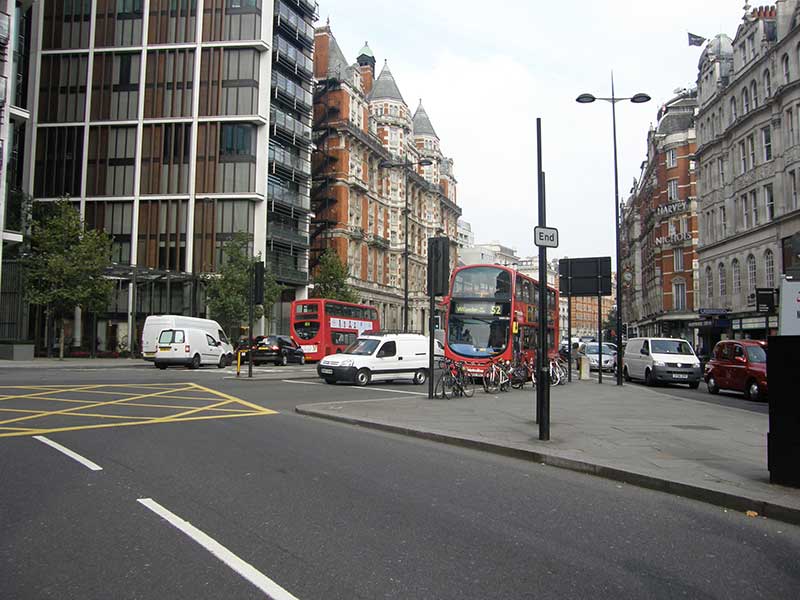
Knightsbridge is an affluent residential and retail district in London with a rich history and high property prices. The area was initially divided between local authorities and has been home to several parishes. Knightsbridge has been associated with exclusive shops, banks catering to wealthy individuals, renowned restaurants, and high-end salons.
Property prices in the district are among the highest in the world. The district has been a target for high-profile crimes throughout history, including the Spaghetti House siege, the Walton's Restaurant bombing, and the Knightsbridge Security Deposit robbery.
The name has Old English origins, meaning "bridge of the young men or retainers", a term coined in the 9th century when the locality was favourite gathering places of young people. In pre-Norman days, did not have the later meaning of a warrior on horseback, but simply meant a youth. The original bridge was where what is now Bompton Road crossed the River Westbourne (Albert Gate). Knightsbridge is also the name of the roadway which runs near the south side of Hyde Park from Hyde Park Corner.
Knightsbridge is east of Exhibition Road and west of Sloane Street. Brompton Road, Beauchamp Place and the western section of Pont Street serve roughly as its southern border together with their adjacent gardens and squares such as Ovington Square, Lennox Gardens and Cadogan Square. South of this area, the district fades into Chelsea while Belgravia lies to the east and South Kensington to the west.
Knightsbridge has its own tube station on the Piccadilly line. It is also served by Sloane Square station on the District and Circle lines.

Plan and Book:


See and Do: Knightsbridge
To the north of the area, is the Hyde Park Barracks of the Household Cavalry, with a distinctive 33-storey tower by Sir Basil Spence. The Royalty and Diplomatic Protection Department is based in Walton Street. The Embassy of Libya is located at 15 Knightsbridge, the Embassy of France at no 58 and the Embassy of Kuwait at 2 Albert Gate, just off Knightsbridge.
On the religious side it contains the impressive Brompton Oratory, a Catholic church on Brompton Road, and the CoE Holy Trinity Church behind it, a Church of Jesus Christ of Latter Day Saints in Exhibition Road, the Russian Orthodox Church in Ennismore Gardens, St Columba's Church of Scotland, Pont Street, and Deutsche Evangelische Christuskirche. The former St Saviour's church, designed by George Basevi, is now a private home.
Shopping
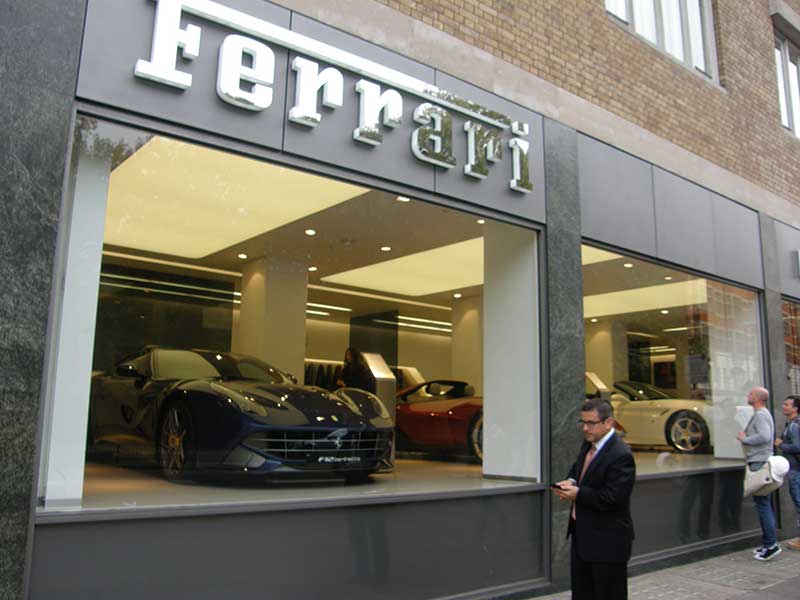
Knightsbridge is home to many expensive shops, including the department stores Harrods and Harvey Nichols, and flagship stores of many British and international fashion houses, including those of London-based shoe designers Jimmy Choo and Manolo Blahnik, and two Prada stores. The district also has banks that cater to wealthy individuals. Some of London's most renowned restaurants are here, as well as many exclusive hair and beauty salons, antiques and antiquities dealers, and chic bars and clubs. One of Bonhams auction houses is located in Knightsbridge.
Harods is the most famous store in London, favoured by the British establishment and owned by the Sovereign Wealth Fund of Qatar. They have a fairly strict dress code so do not turn up looking like a backpacker and expect to gain entrance. Harrods, 87–135 Brompton Rd, Knightsbridge (tube: Knightsbridge).
Harvey Nichols is a large department store full of designer goods and an excellent cafe. 109-125 Knightsbridge (tube: Knightsbridge).
The Duke of York Square Shopping Complex in Chelsea has a range of spacious branches of popular fashion chains, but lacks some of the road's character, however the small adjoining public space of Duke of York square is a welcome place for a rest between shopping, and a popular place to hang out.
King's Road in nearby Chelsea is one of London's smartest fashion streets, having evolved from the cutting-edge of bohemia and innovative fashion in the 60s to a more genteel place to indulge in retail therapy, albeit with a notable presence of trendy young Londoners (including many so called Sloane Rangers). It is a very attractive street that retains the atmosphere of a small town whilst being in the heart of a huge city. There is a huge range of fashion stores from upmarket chains to one-off boutiques, as well as variety of other shops, complimented by cafés, restaurants, bars, pubs and clubs. There is an obvious affluence to the road without any bling or snobbiness. King's Road stretches south-west from here for miles, though the best of the shopping is in the first mile.
Sloane Street is lined with high-end designer label stores. At the end of the 18th century, Henry Holland (architect, builder and father-in-law to ‘Capability’ Brown) developed over 90 acres of Chelsea, designing the street plan for Sloane Street, Sloane Square and Hans Place, as well as many other streets in the locale, as part of the development named Hans Town.
Hyde Park
On the northern perimeter of Knightsbidge is Hyde Park, a Royal Park, and the largest of the parks and green spaces that form a chain from Kensington Palace through Kensington Gardens and Hyde Park, via Hyde Park Corner and Green Park, past Buckingham Palace to St James's Park. Hyde Park is divided by the Serpentine and the Long Water lakes. The park was established by Henry VIII in 1536 when he took the land from Westminster Abbey and used it as a hunting ground. It opened to the public in 1637 and quickly became popular, particularly for May Day parades. Major improvements occurred in the early 18th century under the direction of Queen Caroline.
Popular areas within Hyde Park include Speakers' Corner (located in the northeast corner near Marble Arch), close to the former site of the Tyburn gallows, and Rotten Row, which is the northern boundary of the site of the Crystal Palace. Speakers' Corner has acquired an international reputation for demonstrations and other protests due to its tolerance of free speech. The rise of the Internet, particularly blogs, has diminished the importance of Speakers' Corner as a political platform, and it is increasingly seen as simply a tourist attraction.
A pet cemetery was established at the north edge of Hyde Park in the late 19th century. The last burial took place in 1976. Hyde Park contains several sporting facilities, including football pitches and a Tennis centre. There are numerous cycle paths, and horse riding is popular.
South Kensington-Chelsea District
This district is defined as the southern part of the Royal Borough of Kensington and Chelsea (RBK & C). It includes the area south of the Royal Parks commonly known as High Street Kensington and South Kensington west to Earl's Court and Olympia and south to Sloane Square and Chelsea. Hyde Park and Kensington Gardens combine to form the largest green space in metropolitan London and provide a real oasis in the heart of this vast city.
South Kensington hosts four of London's largest and finest museums and is also home to the venerable Imperial College London. High Street Kensington leads to a long line of shops and department stores, offering a less hectic version of Oxford Street as well very upmarket stores in Knightsbridge. Sloane Street connects Knightsbridge to Chelsea via Sloane Square and is lined with luxury brand boutiques.
Chelsea is a extensive riverside area of London that extends broadly from Sloane Square in the east to the World's End pub in the west and down to the River Thames. The King's Road marks the main thoroughfare of Chelsea.
The whole of the district contains some of the most expensive residential property in the world - being home to countless A-list celebrities (both British and international), as well as a haven for successful businesspeople and other affluent members of society - reflected in the fact politically, the area is the safest Conservative Party parliamentary constituency in the whole of the United Kingdom - yet despite this, it does a little more downmarket towards its western edges.