

London Neighbourhoods:
Bloomsbury
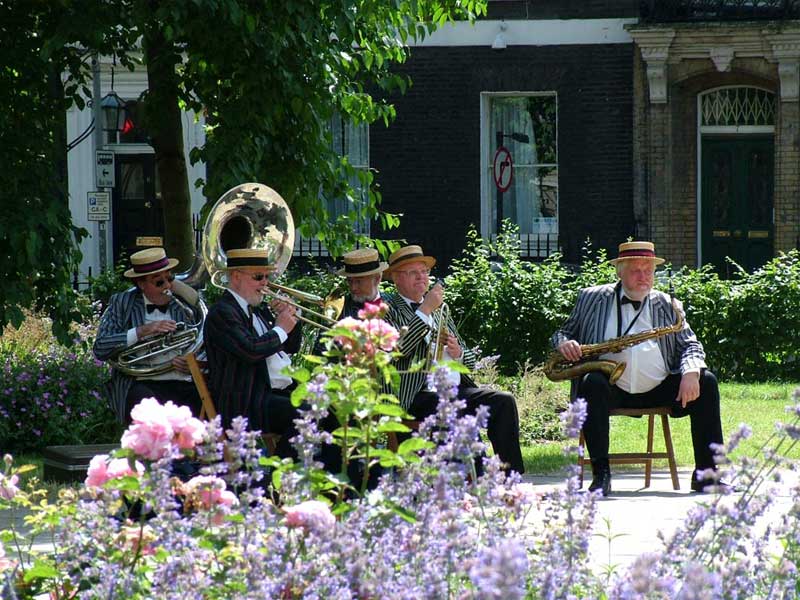
A district in the West End of London, snuggly nestled within Central London is academic and leafy Bloomsbury, an area that boasts walking distance access to many of London's most popular attractions. It is also home to some of Britain's most celebrated museums, including the must-see British Museum. Despite an understandable popularity with students, tourists and day trippers, vast sections of Bloomsbury retain a quiet, residential feel year round and throughout the week.
Bloomsbury began to be developed in the 17th century under the Earls of Southampton,[2] but it was primarily in the 19th century, under the Duke of Bedford, that the district was planned and built as an affluent Regency era residential area by famed developer James Burton. The district is known for its numerous garden squares, including Bloomsbury Square, Russell Square and Bedford Square.
Bloomsbury's built heritage is currently protected by the designation of a conservation area and a locally based conservation committee. Despite this, there is increasing concern about a trend towards larger and less sensitive development, and the associated demolition of Victorian and Georgian buildings.

Online Walks

Things To See and Do
Bloomsbury is home of the British Museum, the largest museum in the United Kingdom, and several educational institutions, including University College London and a number of other colleges and institutes of the University of London as well as its central headquarters, the New College of the Humanities, the University of Law, the Royal Academy of Dramatic Art, the British Medical Association and many others. Bloomsbury is an intellectual and literary hub for London, as home of world-known Bloomsbury Publishing, publishers of the Harry Potter series, and namesake of the Bloomsbury Set, a group of British intellectuals which included author Virginia Woolf, biographer Lytton Strachey, and economist John Maynard Keynes.
The Bloomsbury Festival was launched in 2006 when local resident Roma Backhouse was commissioned to mark the re-opening of the Brunswick Centre, a residential and shopping area. The free festival is a celebration of the local area, partnering with galleries, libraries and museums, and achieved charitable status at the end of 2012. As of 2013, the Duchess of Bedford is a festival patron and Festival Directors have included Cathy Maher (2013), Kate Anderson (2015-2019) and Rosemary Richards (2020-present).
The British Museum, which first opened to the public in 1759 in Montagu House, is at the heart of Bloomsbury. At the centre of the museum the space around the former British Library Reading Room, which was filled with the concrete storage bunkers of the British Library, is today the Queen Elizabeth II Great Court, an indoor square with a glass roof designed by British architect Norman Foster. It houses displays, a cinema, a shop, a cafe and a restaurant. Since 1998, the British Library has been located in a purpose-built building just outside the northern edge of Bloomsbury, in Euston Road.
Also in Bloomsbury is the Foundling Museum, close to Brunswick Square, which tells the story of the Foundling Hospital opened by Thomas Coram for unwanted children in Georgian London. The hospital, now demolished except for the Georgian colonnade, is today a playground and outdoor sports field for children, called Coram's Fields. It is also home to a small number of sheep. The nearby Lamb's Conduit Street is a pleasant thoroughfare with shops, cafes and restaurants.
The Dickens Museum is in Doughty Street. The Petrie Museum of Egyptian Archaeology and the Grant Museum of Zoology are at University College London in Gower Street.
The Postal Museum is on 15-20 Phoenix Place.
Address Book
Notable residents of Bloomsbury included:
Virginia Woolf, considered one of Britain's most important authors.
Vladimir Lenin, founder of the Soviet Union
Hylda Baker, the actress and TV comedienne, had an apartment in Ridgmount Gardens in Torrington Place, Bloomsbury, where she lived throughout the 1960s and 70s when she was in London.
Ada Ballin (1863–1906), magazine editor and writer on fashion.
J. M. Barrie (1860–1937), playwright and novelist, lived in Guilford Street and 8 Grenville Street when he first moved to London; this is where Barrie situated the Darlings' house in Peter Pan.
Vanessa Bell (1879–1961), painter, sister of Virginia Woolf, lived at 46 Gordon Square.
William Copeland Borlase M.P. (1848–1899), died bankrupt and disowned by his family at 34 Bedford Court Mansions.
Vera Brittain (1893–1970) and Winifred Holtby (1898–1935), lived at 58 Doughty Street.
Randolph Caldecott (1846–1886), illustrator, lived at 46 Great Russell Street.
William Cavendish, 3rd Duke of Devonshire (1698–1755), sold the Old Devonshire House at 48 Boswell Street.
Charles Darwin (1809–1882), lived at 12 Upper Gower Street in 1839.
George Dance (1741–1825), architect, lived at 91 Gower Street.
Charles Dickens (1812–1870), novelist, lived at 14 Great Russell Street, Tavistock Square and 48 Doughty Street.
George du Maurier (1834–1896), artist and writer, lived at 91 (formerly 46) Great Russell Street.
Benton Fletcher (1866–1944), housed his keyboard collection at the Old Devonshire House, 48 Boswell Street, in the 1930s and 40s.
E. M. Forster (1879–1970), novelist, essayist, and broadcaster, resided in Brunswick Square
Ricky Gervais (born 1961), comedian, lived until recently in Southampton Row, Store Street and owned one of the penthouses in Bloomsbury Mansions in Russell Square, WC1.
Mary Anne Everett Green (1818–1895), Calenderer of State Papers, author of Lives of the Princesses of England, mother of Evelyn Everett-Green, a prolific 19th-century novelist.
Philip Hardwick (1792–1870) and Philip Charles Hardwick (1822–1892), father and son, architects, lived at 60 Russell Square for over ten years.
Travers Humphreys (1867–1956), barrister and judge, was born in Doughty Street.
John Maynard Keynes (1883–1946), economist, lived for 30 years in Gordon Square.
Vladimir Lenin (1870–1924), founder of the USSR, lived here in 1908.
James Lind of Windsor (1736–1812), natural philosopher, physician to George III
Emanuel Litvinoff (1915–2011), author, poet, playwright and human rights campaigner, lived for 46 years in Mecklenburgh Square.
Edmund Lodge (1756–1839), officer of arms and writer on heraldry, died at his Bloomsbury Square house on 16 January 1839.
Bob Marley (1945–1981), musician, lived in 34 Ridgmount Gardens for six months in 1972.
Charlotte Mew (1869–1928), poet, was born at 30 Doughty Street and lived there until the family moved nearby to 9 Gordon Street, in 1890.
Jacquie O'Sullivan (born 1960), musician and former member of Bananarama.
Dorothy Richardson (1873–1957), novelist, lived at 7 Endesleigh Street and 1905–6 Woburn Walk. Her experiences are recorded in her autobiographical novel, in thirteen volumes, Pilgrimage.;
Sir Francis Ronalds (1788–1873), inventor of the electric telegraph, lived at 40 Queen Square in 1820–1822.
Dorothy L. Sayers (1893–1957), novelist lived at 24 Great James Street from 1921 to 1929. Her main female character Harriet Vane also lived in Bloomsbury.
Alexei Sayle (born 1952), English stand-up comedian, actor and author.
John Shaw Senior (1776–1832) and John Shaw Junior (1803–1870), father and son, architects, lived in Gower Street.
Catherine Tate (born 1968), actress and comedian, brought up in the Brunswick Centre, close to Russell Square.
Wee Georgie Wood (1895–1979), actor and comedian, lived and died at Gordon Mansions on Torrington Place.
Virginia Woolf (1882–1941), author, essayist, and diarist, resided at 46 Gordon Square (1904–07) and 52 Tavistock Square (1924–39).
Thomas Henry Wyatt (1807–1880), architect, lived at 77 Great Russell Street.
John Wyndham (1903–1969), lived at the Penn Club in Tavistock Square (1924–38) and then (except for 1943–46 army service) at the club's present address, 21–22 Bedford Place, off Russell Square, until his marriage in 1963 to Grace Isabel Wilson, who had lived in the next room at the club.
William Butler Yeats (1865–1939), poet, dramatist and prose writer, lived at Woburn Walk.
Design by W3layouts