

London Neighbourhoods
Canary Wharf
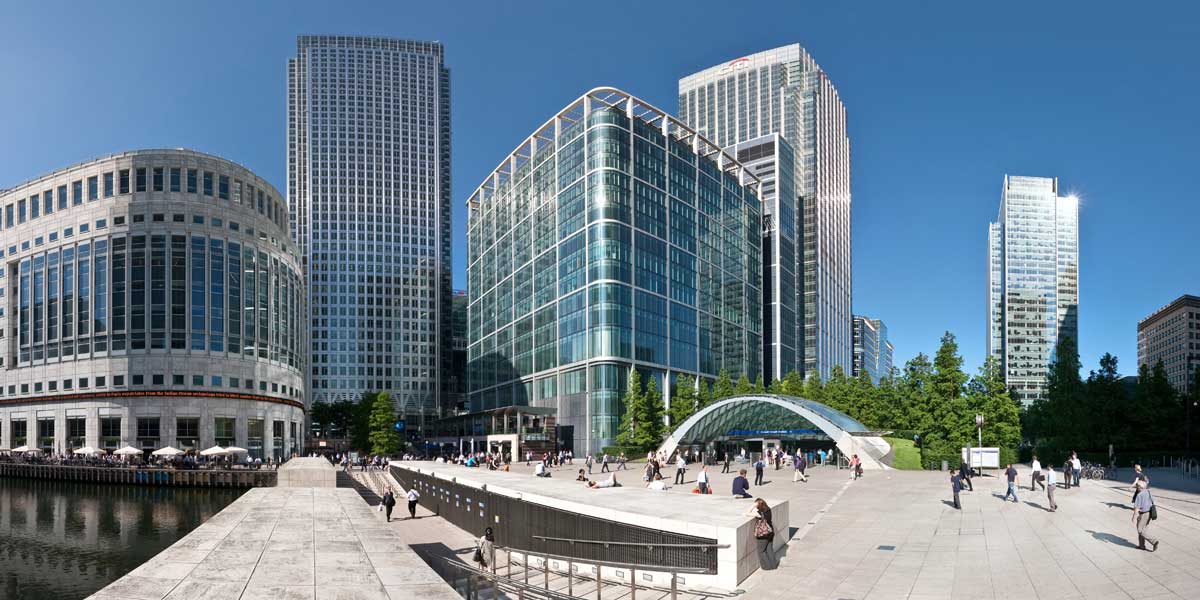
London was once the busiest port in the world. The West India Dock complex, opened in 1803, was the first purpose-built docks to be built there. Closed in 1980, the old docks were regenerated as Canary Wharf, London's hi-tech business area.
Canary Wharf is today a busy financial area filled with skyscrapers like the glittering One Canada Square. Canada Square Park hosts summer concerts and a winter ice-skating rink, while the Museum of London Docklands draws families with model ships and hands-on displays. Casual cafes bustle during the day and, come evening, post-work crowds gather in stylish wine bars and pubs. Ferries called Thames Clippers ply the river.
London City Airport in Silvertown is linked to both Canary Wharf and the City of London via the Docklands Light Railway, and an interchange to the London Underground. Canary Wharf is served by several London Buses routes, including route 135 connecting the estate with Old Street for East London Tech City and Crossharbour and the 24 hours route 277 to Highbury via Bow, Hackney Central, Dalston from Crosshabour via Millwall and also the D prefix network serving the London Docklands with the D3 running between Bethnal Green and Leamouth via Wapping.
The Canary Wharf tube station is a two platform station on the Jubilee Line Extension from Charing Cross to Stratford.
The Canary Wharf Pier is a London River Services pier on the River Thames located to the west of Canary Wharf, close to Narrow Street, Limehouse. The pier is served by two commuter oriented services, both operated by Thames Clipper under licence from London River Services. The main commuter service from central London or Woolwich calls at Canary Wharf Pier on a regular basis.



Online Walks
Now and Then
Canary Wharf and West India Dock
Canary Wharf is one of the United Kingdom's two main financial centres - along with the City of London - and contains many of Europe's tallest buildings, including the second-tallest in the UK, One Canada Square. It is home to the world or European headquarters of numerous major banks, professional services firms, and media organisations, but from 1802 to 1939, the area was one of the busiest docks in the world - the British West India Docks on the Isle of Dogs on the River Thames.
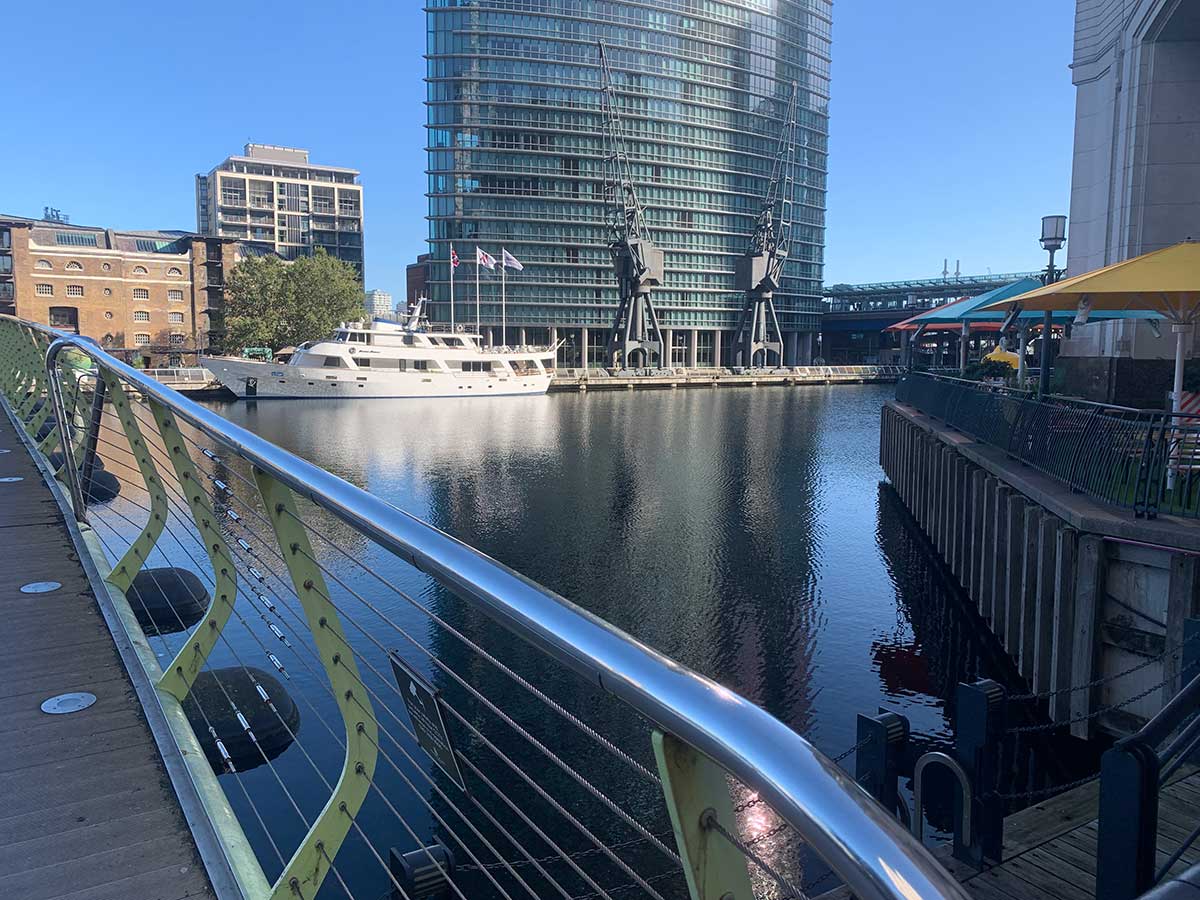
Canary Wharf takes its name from No. 32 berth of the West Wood Quay of the Import Dock. This was built in 1936 for Fruit Lines Ltd, a subsidiary of Fred Olsen Lines for the Mediterranean and Canary Islands fruit trade. The Canary Islands were so named after the large dogs found there by the Spanish (Gran Canaria from Canine) and as it is located on the Isle of Dogs, the quay and warehouse were given the name Canary Wharf. Of the three main docks of the West India Docks, the Canary Wharf estate occupies part of the north side and the entire south side of the Import Dock (North Dock), both sides of the Export Dock (Middle Dock) and the north side of the South Dock.
West India Docks
Despite being outside the centre of London, West India Docks set a precedent for London dock systems, both with its design and operation. Initially it dealt solely with produce from the West Indies, except tobacco, supervising the loading and unloading of vessels as decreed by Parliament. As a result, West India Docks mainly traded in rum, molasses and sugar. Other items that were imported and exported, included: Jute, Coir, Oil, Spirits, Wine, Shell, Horn, Cork, Indigo, Spices, Coffee and Hardwood.
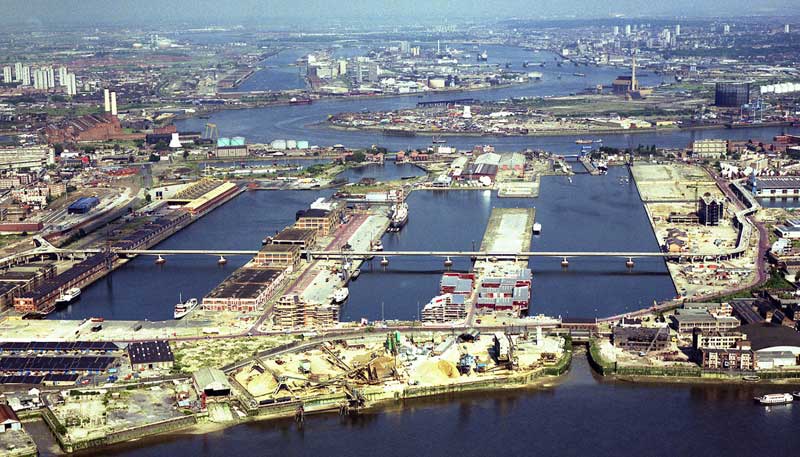
West India Dock before redevelopment
The West India Docks were constructed to berth large sailing vessels and accommodate the many lighters that serviced the Thames. The docks were also used by a large number of barges, which transported coal around London. The Dock's basins allowed up to 20 vessels to enter the system at high tide. The docks could berth a maximum of 600 vessels at any one time.
During the 20th century, the docks also handled grain and, as refrigeration became common, meat, fruit and vegetables also became regular commodities. South West India Dock mainly dealt in the timber trade. In 1943, the Rum Quay at West India Docks was used to build concrete petrol carrying barges for the war. After the 1960s, the port industry began to decline, leading to all the docks being closed by 1980. Canary Wharf itself closed in 1980, the British Government adopted policies to stimulate redevelopment of the area.
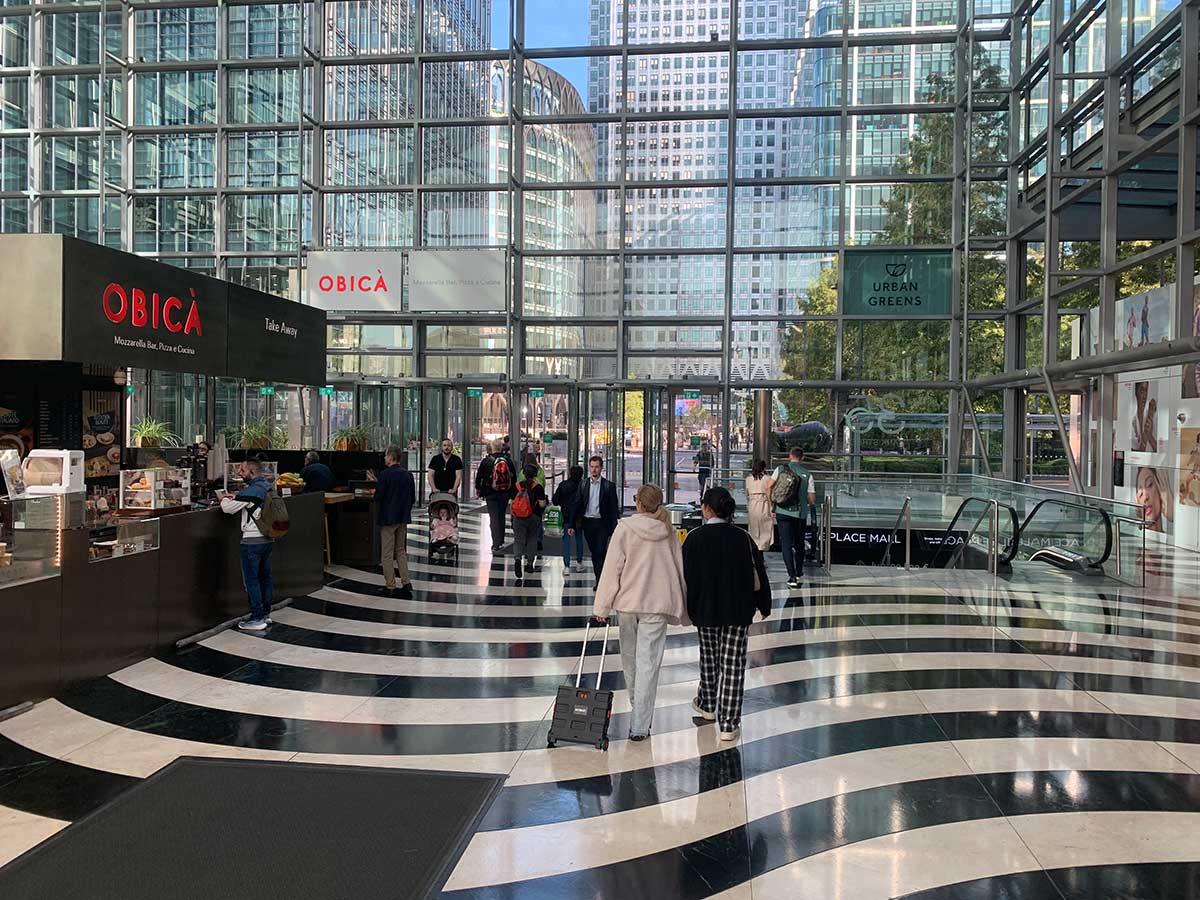
To many Londoners, Canary Wharf is an area best avoided. Full of suited workers in the week, and an apparent ghost town at the weekends, why would anyone visit it? For a start, you can explore Museum of London's eastern outpost which sits in the corner of the North Dock, with 10 permanent galleries covering the history of the Docklands area, including Docklands at War. Entry to the Museum of London Docklands is free, and the museum is open every day.
Canary Wharf is also home to one of the UK's largest collections of public art. There's even an Art Map to tell you what is what and where.
Trinity Buoy Wharf
Trinity Buoy Wharf, to the east of East India Docks, is home to London's only lighthouse offering great views of the Thames and Millennium Dome from within the docklands. It is also home to the 'Long Player', an innovative and ever-evolving composition that has been designed to play steadily without repletion for 1000-years using Tibetan singing bowls. A workspace, events space and arts quarter, it sits within interesting, vibrant surroundings: it is home to the London Parkour Academy, a sculpture park and living/office spaces built entirely from brightly coloured shipping containers. There is plenty to do here and we recommend grabbing a burger and shake from the local Fat Boy's 1940's Diner or a coffee from the Bow Creek Cafe.
The lighthouse was built in 1864 and was a centre of innovation for lighthouse technologies, attracting platers, riveters and tinsmiths from across the country. At one time even Michael Faraday, one of the most influential scientists of all time, carried out experiments in the lighthouse. Closed from 1988 until 1996, it then became what it is today: a bizarre but wonderful destination for an afternoon in the capital.

Crossrail Place is home to Canary Wharf Everyman Cinema, a boutique-style cinema showing a mixture of newly-released and classic films. Expect armchairs and sofas, with foot rests. Posh stuff. A short stroll from the Museum of London Docklands is the 10 screen Cineworld West India Quay, which tends to stick to the newer releases.
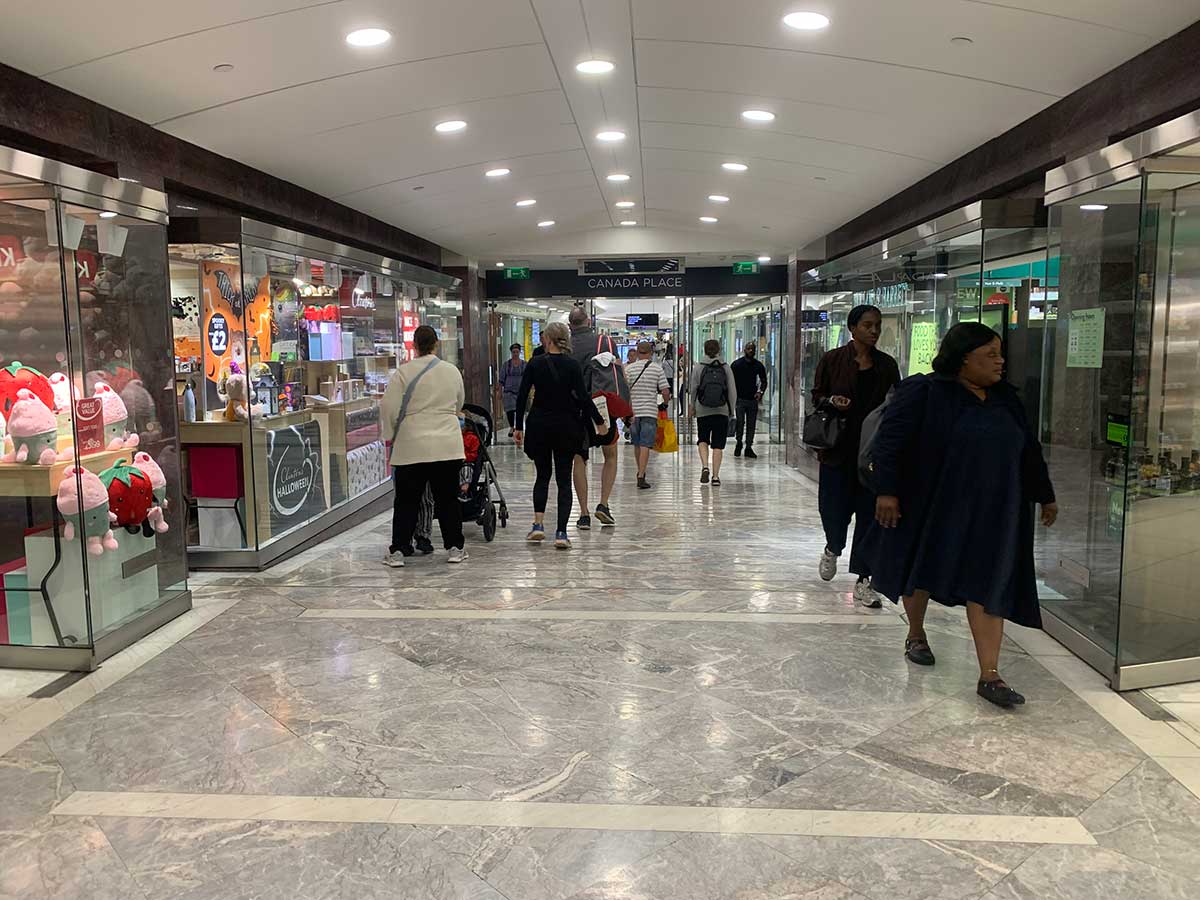
If shopping is more your thing, then you can flash your credit card around in Canary Wharf Shopping Centre, which has everything from high end stores to ones aimed at people with more modest budgets. With an ice skating rink in winter and open air concerts, food markets, and vintage fairs in the summer, there's a decent programme of events going on in and around Canary Wharf - and plenty of them are free. Canary Wharf also has a good range of cafes, bars and restaurants.
Crossrail Place Roof Garden
Before you leave, don't forget to check out the Crossrail Place Roof Garden - part of the Canary Wharf Crossrail station - a free public indoor oasis with each quadrant representing a different hemisphere, another nod to the merchant ships that once travelled across the globe to trade in West India Dock. The station is decorated with a lattice-patterned timber roof inspired by the North Dock's maritime past.
Museum of London Docklands
Housed in a warehouse built 200 years ago to store sugar, coffee and rum, The Museum of London Docklands tells the story of the Thames and its port and the people from all over the world who settled there. Thousands of objects and pictures - many rescued during the 1970s and 1980s when containerisation and competition forced London's port to move downstream - trace the area's history, from the arrival of the Romans to the rise of Canary Wharf.
Historic photographs and printed material from the Port of London Authority Archive show the vast scale of the docks at the turn of the twentieth century and workshop reconstructions illustrate the many traditional port trades, now mostly lost. Metropolitan Fire Brigade footage and captured Nazi footage documents the impact of the Blitz on the area and oral testimonies explore the port's role in secret wartime projects. The Mudlarks gallery for accompanied under-8s includes a water play area (aprons provided) and a soft play zone.
Billingsgate Fish Market
Billingsgate Fish Market is the United Kingdom's largest inland fish market. Billingsgate Wharf, close to Lower Thames Street, became the centre of a fish market during the 16th and 17th centuries but did not become formally established until 1699. Today an average of 25,000 tonnes of seafood products are sold through its merchants each year. The Market complex covers an area of 13 acres and is entirely self-contained. The ground floor of the building comprises a large trading hall with 98 stands and 30 shops, including two cafes whivh serve everything from a full English breakfast to fish and chips.
The stalls and shops sell around 150 varieties of fish brought fresh from British coastal trawlers, Scottish smoked salmon, exotic catches from further afield, gigantic oysters and fish so strange you would have difficulty knowing how to cook them. Most of the fish sold through the market now arrives there by road, from ports as far afield as Aberdeen and Cornwall. Billingsgate Market is open from Tuesday to Saturday. Trading commences at 4am and finishes at 8:30am. Location: Trafalgar Way.
Design by W3layouts