

London Neighbourhoods
Hampstead
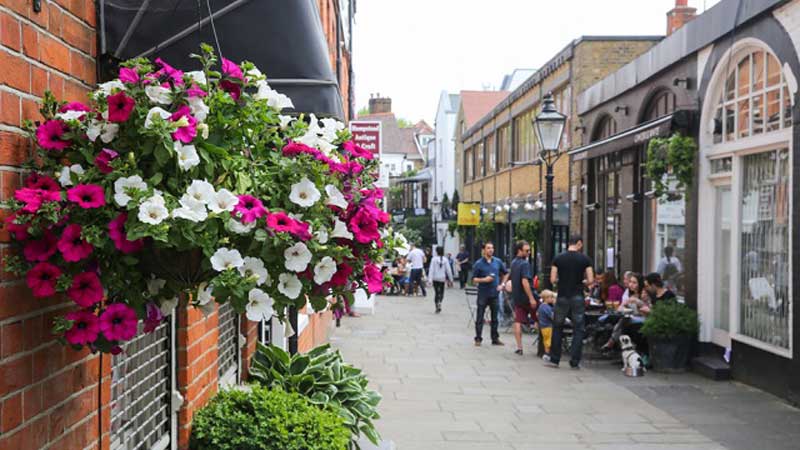
North London's Hampstead is a little village nestled next to Hampstead Heath, one of the city's largest and wildest green spaces. Full of charming streets and literary history, the neighbourhood is a great place to wander through and soak up lovely little details.
Hampstead is a 20-minute Tube ride from Central London on the Northern line, making it easy to reach for a day or just an afternoon.
Cultural attractions in the area include the Freud Museum, Keats House, Kenwood House, Fenton House, the Isokon building, Burgh House (which also houses Hampstead Museum), and the Camden Arts Centre. The large Victorian Hampstead Library and Town Hall was recently converted and extended as a creative industries centre.

Online Walks

Hampstead, commonly known as Hampstead Village, is an area of London, England, 4 miles (6.4 km) northwest of Charing Cross. Part of the London Borough of Camden, it is known for its intellectual, liberal, artistic, musical and literary associations and for Hampstead Heath, a large, hilly expanse of parkland. It has some of the most expensive housing in the London area. The village of Hampstead has more millionaires within its boundaries than any other area of the United Kingdom. The name comes from the Anglo-Saxon words ham and stede, which means, and is a cognate of, the Modern English "homestead".
To the north and east of Hampstead, and separating it from Highgate, is London's largest ancient parkland, Hampstead Heath, which includes the well-known and legally-protected view of the London skyline from Parliament Hill. The Heath, a major place for Londoners to walk and "take the air", has three open-air public swimming ponds; one for men, one for women, and one for mixed bathing, which were originally reservoirs for drinking water and the sources of the River Fleet. The bridge pictured is known locally as 'The Red Arches' or 'The Viaduct', built in fruitless anticipation of residential building on the Heath in the 19th century.
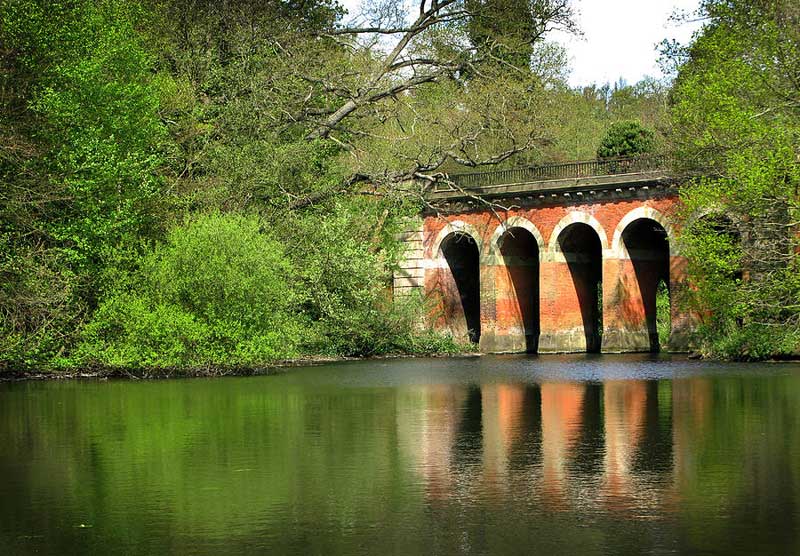
Hampstead Heath Viaduct
Local activities include major open-air concerts on summer Saturday evenings on the slopes below Kenwood House, book and poetry readings, fun fairs on the lower reaches of the Heath, period harpsichord recitals at Fenton House, Hampstead Scientific Society and Hampstead Photographic Society.
The largest employer in Hampstead is the Royal Free Hospital, Pond Street, but many small businesses based in the area have international significance. George Martin's AIR recording studios, in converted church premises in Lyndhurst Road, is a current example, as Jim Henson's Creature Shop was before it relocated to California.
The area has some remarkable architecture, such as the Isokon building in Lawn Road, a Grade I listed experiment in collective housing, once home to Agatha Christie, Henry Moore, Ben Nicholson and Walter Gropius. It was recently restored by Notting Hill Housing Trust.
Local activities include major open-air concerts on summer Saturday evenings on the slopes below Kenwood House, book and poetry readings, fun fairs on the lower reaches of the Heath, period harpsichord recitals at Fenton House, Hampstead Scientific Society and Hampstead Photographic Society.
The largest employer in Hampstead is the Royal Free Hospital, Pond Street, but many small businesses based in the area have international significance. George Martin's AIR recording studios, in converted church premises in Lyndhurst Road, is a current example, as Jim Henson's Creature Shop was before it relocated to California.
Hampstead Address Book
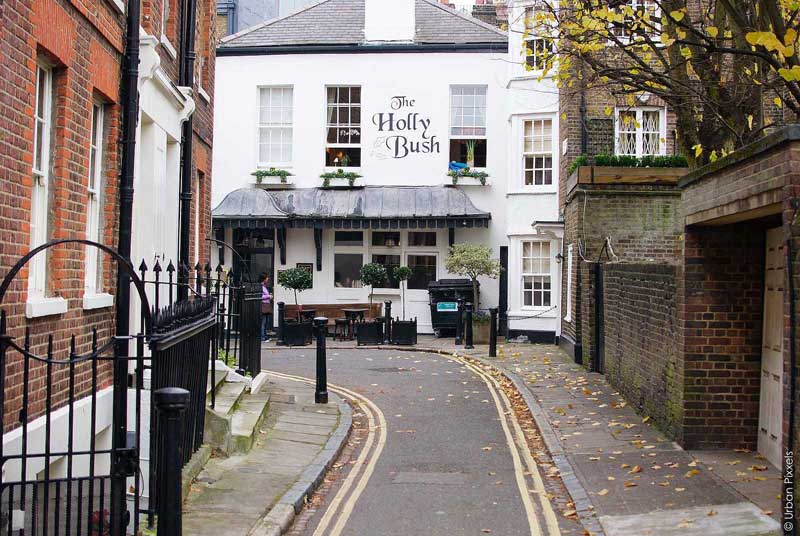
The Holly Bush, at 22 Holly Mount
Hampstead's rural feel lends itself for use on film, a notable example being The Killing of Sister George (1968) starring Beryl Reid and Susannah York. The opening sequence has Reid's character June wandering through the streets and alleyways of Hampstead, west of Heath Street, around The Mount Square. The Marquis of Granby pub, in which June drinks at the opening of the film, was actually The Holly Bush, at 22 Holly Mount. Another example is The Collector (1965), starring Terence Stamp and Samantha Eggar, where the kidnap sequence is set in Mount Vernon.
Some scenes from An American Werewolf in London (1981) are shot on Hampstead Heath, Well Walk and Haverstock Hill. Harry and Judith are killed in Hampstead Heath, behind The Pryors on East Heath Road. Before David kills them, Harry and Judith get out of the taxi on East Heath Road at Well Walk.
More recently Kenwood House is the set of the "film-within-the-film" scene of Notting Hill (1999). Outdoor scenes in The Wedding Date (2005), starring Debra Messing, feature Parliament Hill Fields on the Heath, overlooking west London. Parliament Hill also features in Notes on a Scandal (2006) together with the nearby areas of Gospel Oak and Camden Town. Four Weddings and a Funeral (1994) features the old Hampstead Town Hall on Haverstock Hill. The cult film Scenes of a Sexual Nature (2006) was filmed entirely on Hampstead Heath, covering various picturesque locations such as the 'Floating Gardens' and Kenwood House.
A musical specifically focusing on the area, Les Bicyclettes de Belsize (1968), tells the story of a young man's cycle journey around Hampstead. After crashing into a billboard poster, he falls in love with the fashion model depicted on it.
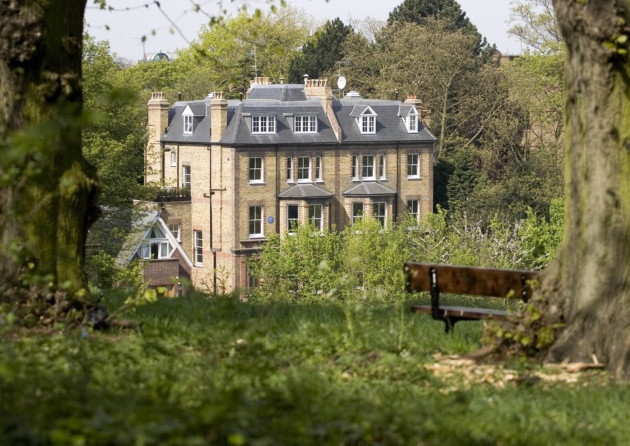
The Chestnuts, 1 Branch Hill, Hampstead
The Chestnuts, 1 Branch Hill, Hampstead, London: Singer and Actor
Paul Robeson (1898-1976) lived here 1929-1930. The American singer,
actor and civil rights activist Paul Robeson was one of the first black
performers to achieve world renown. At the peak of his fame in
1929–30 he lived at The Chestnuts.
6 Lyndhurst Road, Hampstead, London: film and theatre actor Richard
Burton (1925-1984) lived here 1949-1956. He shared the home with his
first wife Sybil Williams. They moved into 6 Lyndhurst Road in 1949 and
stayed there until 1956, during which time Burton rose to fame as a
Shakespearean actor at the Old Vic, and later as a Hollywood star.
8 Meadway, Hampstead Garden Suburb, London: Actor of theatre and film Robert Donat (1905-1958) lived here.
Bedegar's Lea, Kenwood Close, Hampstead Garden Suburb, London: Theatre
and film actor Sir Ralph Richardson (1902-1983) lived here, 1944-1968.
George Orwell lived and worked in a bookshop between 1935-35 at 77 Parliament Hill, Hampstead. Eric Arthur Blair (1903-1950), better known by his pen name George Orwell, was an English novelist and journalist. His work is marked by keen intelligence and wit, a profound awareness of social injustice, an intense opposition to totalitarianism, a passion for clarity in language and a belief in democratic socialism.
Design by W3layouts