

London Destinations:
Primrose Hill
Primrose Hill is a surprisingly steep green mound overlooking London, lined with broad trees and crisscrossed with ribbons of paths, surrounded by houses many of which have pastel-coloured facades and beautiful architectural styles. Along its wishbone-shaped high streets you can buy anything, but they are remarkably free of chain stores.
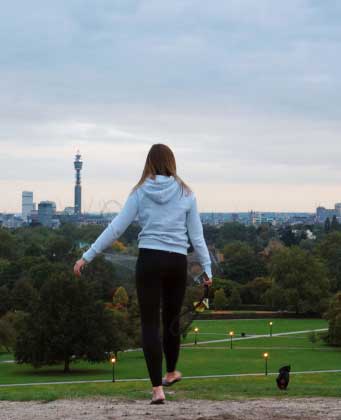
The Primrose Hill district is surrounded by St John's Wood to the west, Swiss Cottage to the northwest, Belsize Park to the north, Chalk Farm to the northeast, Camden Town to the east and Regent's Park itself lies adjacent to the south of the hill itself. The nearest stations to Primrose Hill are Chalk Farm tube station to the northeast and Swiss Cottage tube station to the northwest. The defunct Primrose Hill railway station, now housing a business, sits on the railway lines that separate the Primrose Hill area from Camden Town. Primrose Hill Tunnel, the first railway tunnel in London, has had its eastern portals Grade II - and its western portals Grade II listed since 1974.
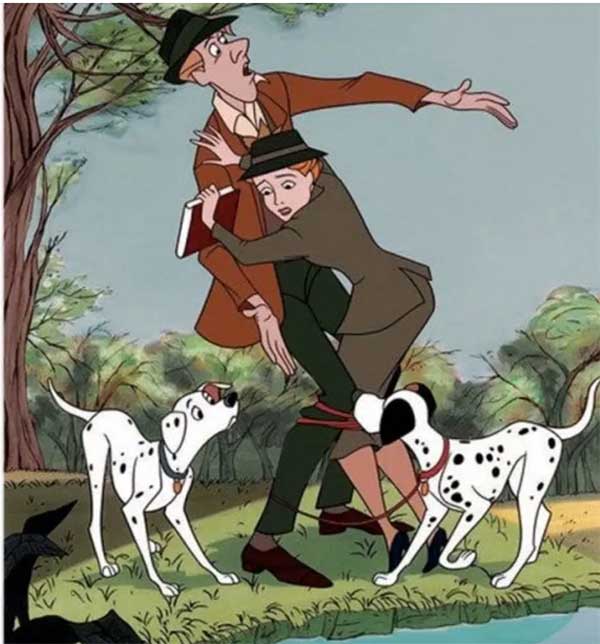
The genteel, holidaying-in-the-Mediterranean atmosphere of the place hides a burning sense of local identity, celebrated in literature and film. The top of Primrose Hill itself is where Pongo and Perdita resort to the twilight bark in search of their 15 missing puppies in the Disney classic 101 Dalmatians, and where the Martians finally expire through disease in the last pages of HG Wells's The War of the Worlds. It is the focus of Kingsley Amis's novel The Folk Who Live on the Hill and of journalistic parodies by Alan Bennett and Mark Boxer. Bridget Jones: The Edge of Reason was partially filmed on Primrose Hill. Primrose Hill was a key location in Paddington and Paddington 2.

Online Walks

Situated to the north of Regent's Park, Primrose Hill is a popular and fashionable region of northern London, offering panoramic views of the surrounding neighbourhoods. The name Primrose Hill derives from the grassy hill that is central to the region.
The hill was recognised as being of significance in 1842 when an Act of Parliament was passed to protect the hill as a public area. Around the public land, there are rows of pretty Victorian terraces that have stood the test of time and remain popular with the City set. Primrose Hill is situated conveniently close to the city centre, while escaping the most densely populated inner city locations. Unsurprisingly, this means that Primrose Hill is expensive and fashionable for both locals and visitors.
The locality is a close-knit neighbourhood village, but then many London areas are. Tourists may find it odd, but this metropolis is both one of the world's big cities and an archipelago of little boroughs which still retain the air of the villages they were not long ago, before being devoured by the ever-expanding Greater London megalopolis.
Primrose Hill has a character all of its own, at the summit of this grassy hill are some spectacular views across London. It is separated from Regent's Park by Prince Albert Road and the ZSL London Zoo. Like Regent's Park, this area was once part of a great chase, appropriated by Henry VIII. Primrose Hill, with its clear rounded skyline, was purchased from Eton College in 1841 to extend the parkland available to the poor people of north London for open-air recreation.
Elliott Square is a grouping of modernist 1960s houses by Douglas Streeter, built as part of the Chalcot Estate on land owned by Eton College.
At one time this was a place where duels were fought and prize-fights took place. The hill has always had a somewhat lively reputation, with Mother Shipton making threatening prophesies about what would happen if the city sprawl was allowed to encroach on its boundaries.
At the top of the hill is one of the six protected viewpoints in London. The summit is almost 63 metres above sea level and the trees are kept low so as not to obscure the view. In winter, Hampstead can be seen to the northeast.
Camden Town
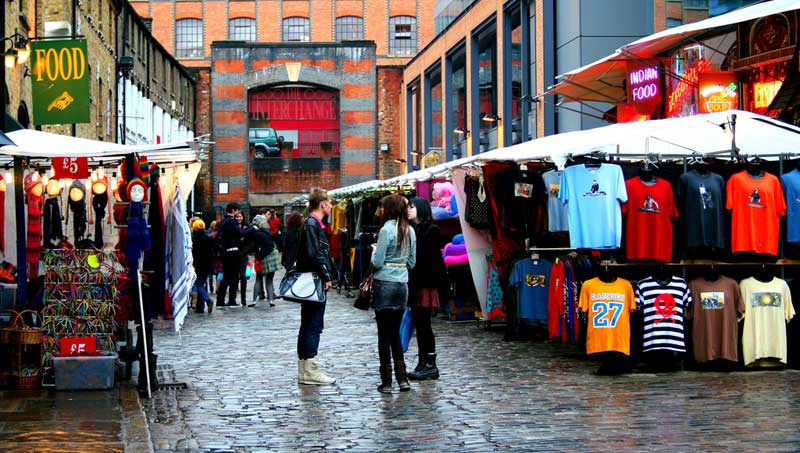
Neighbouring Camden Town offers an eclectic mix of markets, cuisines and live music venues. Camden Town has been a residential area since the 1790s. But it was only the development of the Grand Union Canal and the improved railway transport that turned it into a bustling part of London. Today, visitors and locals gather here to hunt for treasures in Camden's markets, stroll by Regent's Canal, sample cuisine from around the world and listen to live music. Many famous people, including Dylan Thomas, Walter Sickert and Amy Winehouse, have made Camden their home.
Primrose Hill Address Book
The Primrose Hill district is an archetypal example of a successful London urban village, due to the location and the quality of its socio-historical development, and is home to many prominent residents. Many writers, poets and artists have lived in Primrose Hill, including Martin Amis, Isabel Fonseca, Ian McEwan, and before them WB Yeats, Ted Hughes and Sylvia Plath, who committed suicide here. A disproportionate number of celebrities live in Primrose Hill, eat in its restaurants, frequent its shops, meet in its bars.
There are seven English Heritage blue plaques in Primrose Hill commemorating the historic personalities that have lived there. The plaques mark the residences of poet Sir Hugh Clough, historian and broadcaster A. J. P. Taylor and painter William Roberts at 11, 13, and 14 St Mark's Crescent respectively; revolutionary socialist and philosopher Friedrich Engels at 122 (and later 41) Regent's Park Road; photographer Roger Fenton at 2 Albert Terrace; poet and novelist Sylvia Plath at 3 Chalcot Square; and poet William Butler Yeats at 23 Fitzroy Road.
Stanley Johnson and Lukas Heller each lived at different times at the 'Rocking Horse House' on Regent's Park Road. Broadcasters Joan Bakewell and Nicholas Crane and actors Daisy Ridley and Derek Jacobi live in the area.
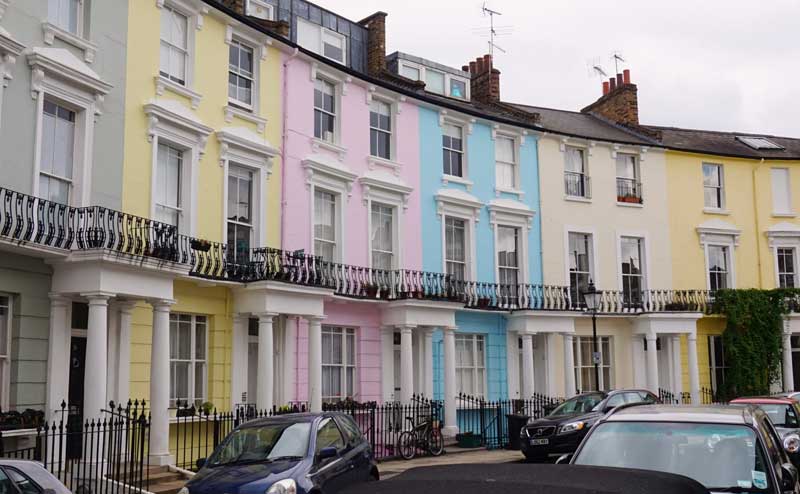
Chalcot Square, Primrose Hill
The American poet Sylvia Plath lived at
two addresses in Primrose Hill in the early 1960s - 3 Chalcot Square,
where she lived with her husband Ted Hughes from January 1960 until
August 1961, when they moved to Devon. In December 1962, Plath left
Devon with her children and returned to Primrose Hill, moving to 23
Fitzroy Road. This house had been the boyhood home of the Irish poet
and dramatist William Butler Yeats.
Design by W3layouts