

London Neighbourhoods
Tilbury, UK
Tilbury is a port town in the borough of Thurrock, Essex. The present town was established as separate settlement in the late 19th century, on land that was mainly part of Chadwell St Mary. It contains a 16th century fort and an ancient cross-river ferry. Tilbury is part of the Port of London with a major deep-water port which contributes to the local economy.
Situated 38.5 km east of central London and 37 km southwest of Southend-on-Sea (the nearest city), Tilbury is on the north bank of the River Thames, where the river's meander has caused it to narrow to approximately730 metres in width. The area to the north is one-time marshlands; to the north of that there is higher ground, where lie the villages of Chadwell St Mary, West and East Tilbury. The town lies to the north of the London-Southend railway line.
Tilbury's history is closely connected with its geographical location. Its counterpart on the south bank of the River Thames, Gravesend, has long been an important communications link, and it was there that a cross-river ferry was connected, mainly due to the narrowness of the river at this point. In addition, Gravesend and Northfleet (also on the south shore) both became vitally important to shipping on the Thames: the former as the first port of call for foreign shipping bound for London, and the latter as a naval dockyard.
Plan and Book:


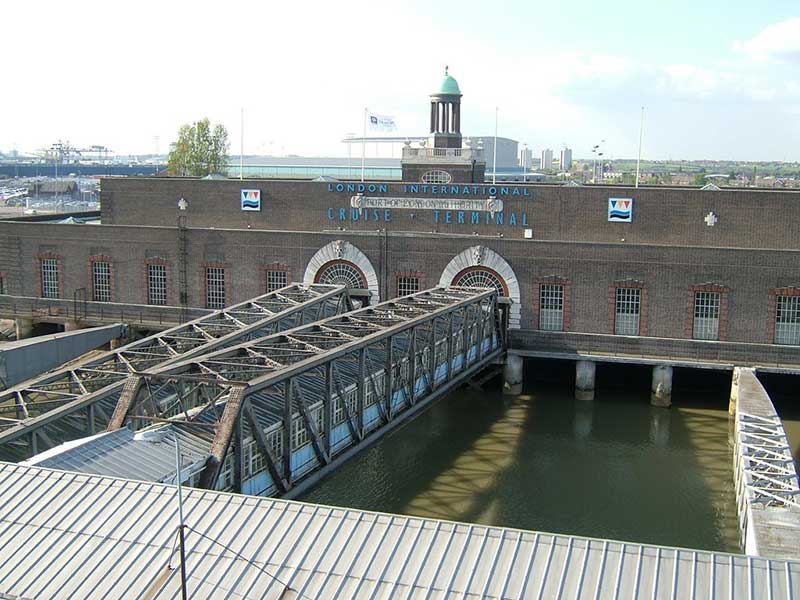
The Port of Tilbury handles a variety of bulk cargo, timber, cars and container traffic and remains, along with Southampton and Felixstowe, one of Britain's three major container ports. It is the main UK port for importing paper, including newsprint. The one-time passenger landing stage was reopened by the Port of Tilbury group as the London Cruise Terminal, though it is no longer served by the railway. Until the introduction of standardised containers, the majority of the town's inhabitants were employed in the docks. The resulting loss of jobs has never been made up.
Tilbury: See and Do
The quays extend more than 6.5 km, and the riverside landing stage, 348 m long, enables the largest ships to embark or disembark passengers at any stage of the tide. The East End has always been a place of international arrival and departure, today from the old Royal Docks you can fly into or out of London City Airport. The Airport is part of the Docklands urban regeneration, which is the world's biggest single civil engineering project and is creating a new financial centre that rivals the City of London.
The major landmarks are the docks, the cruise-ship landing stage (photo above), and the Tilbury Power Station. There are two churches in Tilbury: St John's (Church of England) and Our Lady Star of the Sea (Roman Catholic); there is also a Convent of Mercy. There is, in addition, a synagogue in Dock Road. The educational institutions in Tilbury include primary education, which are Lansdowne Primary School, St Mary's RC Primary School and Tilbury Manor Primary School renamed Tilbury Pioneer Academy when the school was taken over by the Gateway Learning Community, a local collective of several schools in the local area. The last serve Infant and Nursery, as well as Junior children. Lying just outside the town is the Gateway Academy, the main secondary school for Tilbury, Chadwell St Mary and the eastern parts of Grays, as well as the adjoining Gateway Primary Free School. Additionally, USP College (Palmers Campus) lies in east Grays near Tilbury.
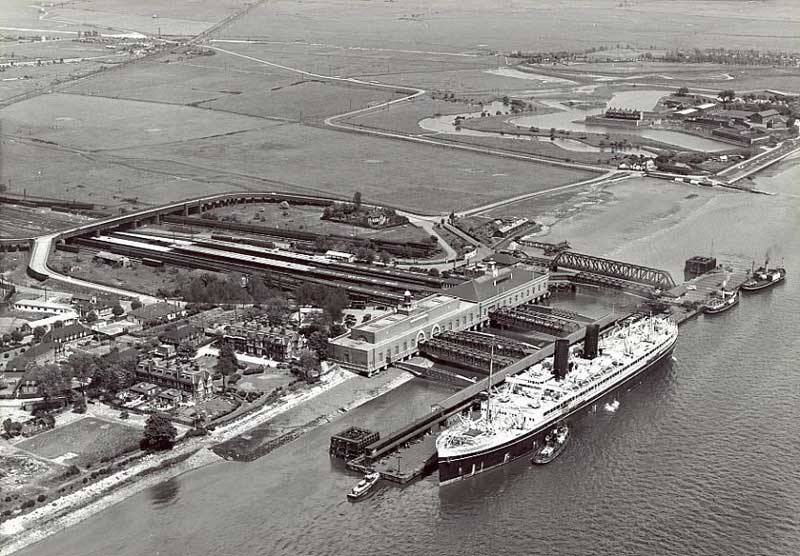
SS Moultan berthed at the Passenger Terminal, 1923
Passenger Traffic in the 20th Cemury
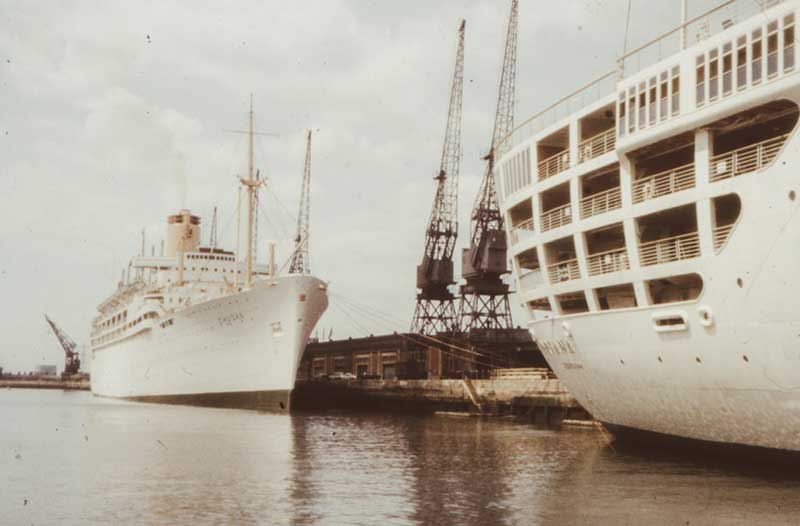
As result of the 19th century British colonial expansion, the early 20th century saw significant increases in long distance passenger travel by sea. By 1922 this increased demand, and a lack of centralised facilities for passengers, led to the building of a Cruise Terminal and Passenger Landing Stage that were officially opened on 16th May 1930. It was from this terminal that I would sail with my family on RMS Strathairld to Meklbourne, Australia, in June 1960.
Previously passengers were conveyed between ship and shore by private vessels, however the new Landing Stage was constructed as a floating platform, projecting out 113 metres from the riverbank. This enabled direct passenger transfer via elevated gantries. At the western end of the stage a two storey wooden building 132 metres long was constructed with offices for customs, immigration, and waiting rooms. Four bridges connected the floating stage to the land / baggage hall. A fifth bridge was constructed for vehicles. The Riverside Station was also enlarged with a new station building, added lines, and platforms, making the journey time to central London forty-five minutes.
It was through the terminal and adjoining Riverside railway station that hundreds of thousands of immigrants left the shores of the British Isles to start a new life in far-off places such as South Africa, Australia and New Zealand during the first half of the 20th century. Opened on 13 April 1854 as part of the London, Tilbury and Southend Railway provided an interchange with Tilbury Docks to take advantage of the increasing steamboat traffic in this area of the river Thames.
By 1929 passenger numbers for the year had reached 306,000. Until World War II the terminal was in high demand, and served ships sailing to India, the Far East, Australia and New Zealand. During the summer months there were also pleasure cruises to the Mediterranean, Canary Islands, Scandinavia, and the Baltic. World War II diverted the work of the Cruise Terminal, and after the war, the return to normal operations were slow. By the end of the 1940s the passenger trade had revived, and was once again thriving.
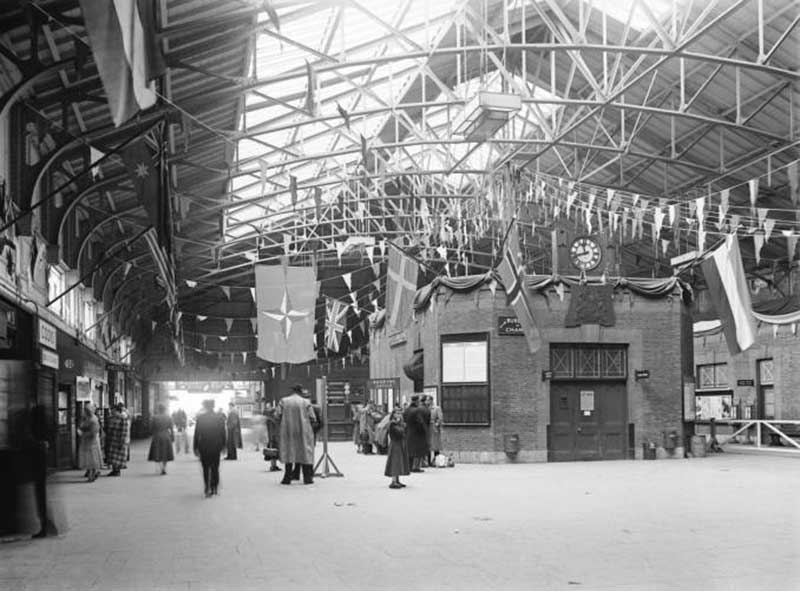
In 1953 another cargo and passenger terminal was built and opened in 1957 just as air travel expanded and sea travel were about to go into rapid decline. Twelve years later the terminal was closed and the buildings are now used for storage. Today, the direct rail links to the Riverside Station have been severed, the station was closed and left semi-derelict in 1992. However the original Cruise Terminal and Landing Stage, opened on 16 May 1930, are still in use, in a reduced way, it serves the ferry service to Gravesend from the Eastern End of the landing stage, and cruise ships during the summer months.