

City of London and Neighbouring districts
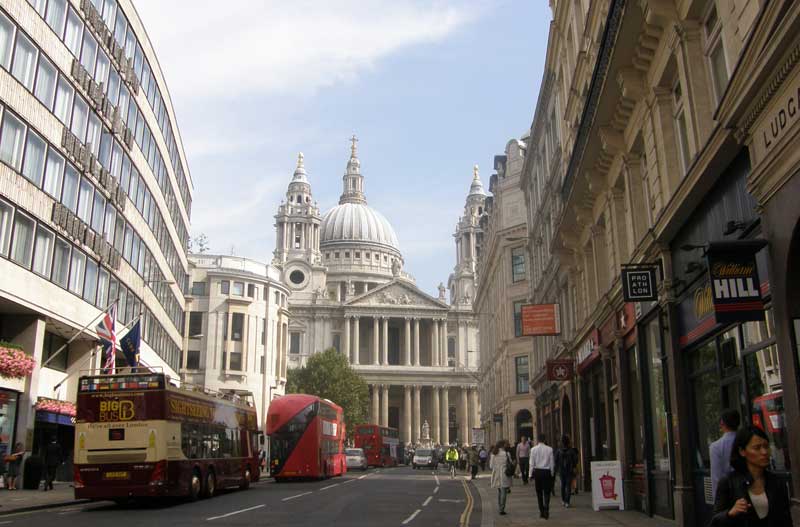
From its ancient past as a Roman trading outpost to its 21st century
status as the wealthiest square mile in the world, the financial
district known simply as “The City” is one of London's most
historic and fascinating neighbourhoods. Here high rise office towers
such as Norman Foster’s Gherkin mingle with Roman ruins and
architectural marvels from virtually every era in between, including
Christopher Wren's glorious St.Paul's Cathedral, and John Soane's
dauntingly classicist Bank of England. This neighbourhood is also home
to some of the finest restaurants and plushest hotels in Europe, in
addition to an assortment of of watering holes, upscale shops, and Tube
stations. During the week, the City is abuzz with white collar workers
going about their business; the weekend sees this area turn into a
quiet haven for sightseers.


Online Walks
Now and Then
City of London
The City of London is also known as "The Square Mile" and is as its nickname implies approximately one square mile in area (about 2.5 square kilometres). Originally enclosed by a city wall it is now the financial district of modern London. Historically the Roman city of Londinium was founded here, and for hundreds of years the city has been the country's centre of trade and commerce. Expansion outside the original square mile started to take place in earnest during the 18th century and by the 19th century the original City was only a small part of the wider metropolis. The map below shows the City of London in about 1830.
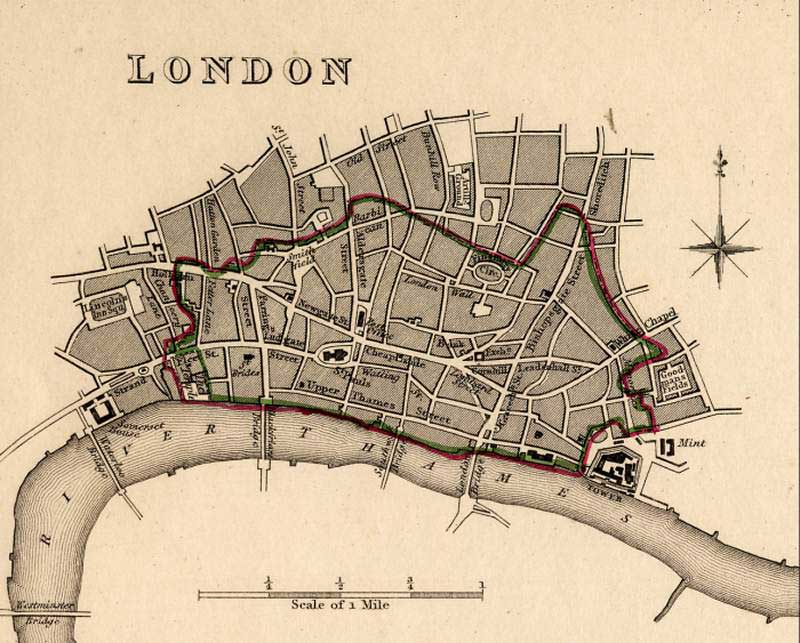
London city map, 1830
The City of London (usually referred to simply as "The City") is where you can find the stunning St. Paul's Cathedral within its reaches, as well as the Tower of London. It is also here that you'll find the iconic Tower Bridge (not to be mistaken with London Bridge) that you'll no doubt recognize from its many appearances in film and television throughout the years. Also in the City are fragments of the original city walls. The role that they played and the history of this city are explained in detail at the Museum of London.
Places of Interest:
St Paul's Cathedral | Paternoster Square | Tower Bridge | Tower of London | Millennium footbridge | Museum of London | City of London Police Museum | Liverpool Street Station | Fenchurch Street Station | Sky Garden | London Bridge.
Holborn
Inner London's busiest streets crisscross quiet cobbled lanes for an
effect that can be urbane or quaint – or an intriguing blend of
both – depending on the particular corner you turn. Due to its
especially convenient location, bustling Holborn hosts an excellent
range of hotels, eateries, and shops to suit practically any taste or
budget. With major attractions like the British Museum and Somerset
House as well as popular areas such as Covent Garden and Soho all just
a short walk away, Holborn is a smart base from which to explore
London.
Nearby Places of Interest:
Lincoln's Inn Fields | University of The Arts London | /Museum of Freemasonry | Sir John Sloane's Museum | Charles Dickens Museum.
Barbican
The Barbican Estate is a residential estate built during the 1960s
and the 1970s within the City of London in Central London, in an area
once devastated by World War II bombings and today densely populated by
financial institutions. It contains, or is adjacent to, the Barbican
Arts Centre, the Museum of London, the Guildhall School of Music and
Drama, the Barbican public library, the City of London School for Girls
and a YMCA (now closed), forming the Barbican Complex. The main fort of
Roman London was built between 90 and 120 AD southeast of where the
Museum of London now stands at the corner of London Wall and Aldersgate
Street. Around 200 AD walls were built around the city that
incorporated the old fort, which became a grand entrance known as
Cripplegate. The word barbican comes from the Low Latin word Barbecana
which referred to a fortified outpost or gateway, such as an outer
defence of a city or castle or any tower situated over a gate or bridge
which was used for defence purposes.
Nearby Places of Interest:
Guildhall School of Music and Drama | Roman London Wall | Museum of London | Roman Fort Ruins | Barbican Theatre | Barts Pathology Museum | Smithfield Market.
Finsbury
Finsbury is a bustling commercial area on the edge of the City of London financial district. Lunchtime food spots, chic bars, and global restaurants around Broadgate Circle serve workers from the area’s offices and banks, while nearby streets are home to jewellery, electronics, and fashion stores. Moorgate and Liverpool Street stations are busy commuter hubs. Compact Finsbury Square has a bowling green and a cafe.
Nearby Places of Interest:
Liverpool Street Station | St Luke Old Street | Ironmonger Row Baths | Whitecross Street Market | Finsbury Square | King Square Gardens | Artillery Ground.
Victoria Embankment
Victoria Embankment is part of the Thames Embankment, a road and
river-walk along the north bank of the River Thames in London. It runs
from the Palace of Westminster to Blackfriars Bridge in the City of
London. As well as being a major thoroughfare for road traffic between
the City of Westminster and the City of London, it is noted for several
memorials, such as the Battle of Britain Monument, permanently berthed
retired vessels, such as HMS President, and public gardens, including
Victoria Embankment Gardens. Notable attractions include the General
Charles Gordon Memorial, Royal Air Force Memorial, National Submarine
War Memorial, Battle of Britain Monument, Cleopatra's Needle and the
modernistic Cleopatra's Kiosk. The neighbouring Temple, in the vicinity
of Temple Church, is one of the main legal districts of the capital and
a notable centre for English law, both historically and in the present
day.
Nearby Places of Interest:
Westminster Bridge | Westminster Pier | The Royal Horse Guards | Playhouse Theatre | Cleopatra's Needle | Waterloo Bridge | Somerset House | King's College, London | Temple Gardens | Blackfriars Bridge.
Neighbouring Districts
Trafalgar Square
With its iconic Nelson's Column, majestic oversized lions and
brightly-lit fountains, Trafalgar Square is not just considered the
heart of this bustling London hub, but the very core of the city
itself. Beyond this esteemed gathering place are more famous icons, as
well as a disproportionate numbers of the city's most popular
cultural attractions including the National Gallery and many West End
theaters. Along the way to these major sites are quiet lanes and
antiquated pubs to discover, as well as riverside vistas to enjoy on
the embankment. With a calendar full of celebratory events, any time of
year is a fine time to visit.
Nearby Places of Interest:
Admiralty Arch | Benjamin Franklin House | Strand | Charing Cross Station | Household Cavalry Museum | Scotland Yard | Nelson's Column | St Martin-In-The-Fields | The National Gallery | National Portrait Gallery.
Leicester Square
With Trafalgar Square to the south, Piccadilly Circus to the west,
China Town to the north and Covent Garden to the east, Leicester Square
is right in the thick of London's West End. It is the beating heart of
British cinema, with all the major European premieres happening there -
you'll often see crowds of fans, expectantly awaiting the arrival of
the stars outside one of the state-of-the-art cinemas which line the
square. Bronze casts of actors' hand imprints also remind you of the
film star glamour associated with Leicester Square - Tom Cruise, Bruce
Willis, Sylvester Stallone and Sir Ian McKellen are just some of the
A-listers who've contributed.
Nearby Places of Interest:
Adelphi Theatre| Vaudeville Theatre | Wyndham's Theatre | Leicester Square Theatre | Prince of Wales Theatre | Garrick Theatre | The National Gallery | National Portrait Gallery | Harold Pinter Theatre; The Apollo Theatre | Gielgud Theatre | Sondheim Theatre | Her Majesty's Theatre | Picadilly Theatre | Genting Casino Chinatown | The Hippodrome Casino | Empire Casino | Piccadilly Circus.
King's Cross
Named after a vast monument dedicated to King George IV in 1835,
which used to stand where the railway station is today, King's Cross
was developed on the site of a village previously known as Battle
Bridge. This village was located by an ancient crossing of the River
Fleet and was rumoured to be the setting for a major battle between the
Romans and Queen Boudicca's Iceni tribe. King's Cross was one of
London's poorest districts in the 19th century and was the playground
of Dickens' Oliver Twist. Today King's Cross is known as one of Central
London's terminus railway stations.
Nearby Places of Interest:
King's Cross Station | St Pancras Station | British Library | Euston Station.
Charing Cross
Charing Cross denotes the junction of Strand, Whitehall and Cockspur
Street, just south of Trafalgar Square in central London. It gives its
name to several landmarks, including Charing Cross railway station, one
of the main London rail terminals. Charing Cross is named after the
Eleanor cross that stood on the site, in what was once the hamlet of
Charing. The site of the cross has been occupied since 1675 by an
equestrian statue of King Charles I. A loose Victorian replica of the
medieval cross, the Queen Eleanor Memorial Cross, was erected a short
distance to the east outside the railway station. The name of the area,
Charing, is derived from the Old English word "cierring", referring to
a bend in the River Thames.
Nearby Places of Interest:
Charing Cross Station | Victoria Embankment | Adelphi Theatre| Vaudeville Theatre | Wyndham's Theatre | Leicester Square Theatre | Prince of Wales Theatre | Garrick Theatre | The National Gallery | National Portrait Gallery | Trafalgar Square | Nelson's Column | Old War Office
St Pancras
For many centuries the name was used for various
officially-designated areas, but it is now used mainly for the railway
station and for upmarket venues in the immediate locality, having been
largely superseded by other place names including Kings Cross and
Somers Town. St Pancras was originally a medieval parish, which ran
from close to what is now Oxford Street north as far as Highgate, and
from what is now Regent's Park in the west to the road now known as
York Way in the east, boundaries which take in much of the current
London Borough of Camden, including its central part. However, as the
choice of name for the borough suggests, St Pancras has lost its status
as the central settlement in the area.
Nearby Places of Interest:
King's Cross Station | St Pancras Station | British Library | Euston Station.
Clerkenwell
Clerkenwell developed around the Nunnery of St. Mary (replaced by St. James, Clerkenwell Green, in 1792) and the Priory of St. John of Jerusalem, both founded in the 12th century by Jorden de Briset, and grew with the overflowing population of central London. In the mid-17th century it was home to many Huguenot refugees, merchants, and tradesmen, as well as to such uncouth locales as the Red Bull Theatre. It was a focus of suffering during the Great Plague of London. The watchmaking and watch repairing trades were once of great importance, particularly in the area around Northampton Square. In the 20th century, Clerkenwell became known as a centre for architecture and design. After the Second World War Clerkenwell suffered from industrial decline and many of the premises occupied by the engineering, printing publishing and meat and food trades fell empty. A general revival and gentrification process began in the 1980s, and the area is now known for loft-living in some of the former industrial buildings. It is also home to many professional offices as an overspill for the nearby City of London and West End.
Covent Garden
Whether you're headed here to check out the multitude of shops,
theaters, cafes, pubs, and restaurants, or simply to be among the
multitude of people who pass through this pretty part of town, you'll
love soaking up the festive and historic atmosphere in and around
Covent Garden.
Even if you don't have tickets to the opera or a show at
one of the many famous theaters here, don't be surprised if find
yourself captivated by some impromptu act of a street performer wowing
the crowds in Covent Garden's Piazza. If you do have tickets, you'll be
pleased to note that many of the local eateries accommodate
theatergoers with prix fixe menus, early dinners, and later than usual
opening hours.
Nearby Places of Interest:
Lyceum Theatre | London Transport Museum | London Film Museum | Linbury Studio Theatre | Theatre Royal Drury Lane | Duchess Theatre | Novello | Royal Opera House | London Film School.
Bloomsbury
Snuggly nestled within Central London is academic and leafy
Bloomsbury, an area that boasts walking distance access to many of
London's most popular attractions. It is also home to some of Britain's
most celebrated museums, including the must-see British Museum. Despite
an understandable popularity with students, tourists and day trippers,
vast sections of Bloomsbury retain a quiet, residential feel year round
and throughout the week. After Covent Garden, Bloomsbury Square is the
oldest square in London. The garden has circle of lime trees at the
centre, shaded walks, deciduous planting around the edge and oval
planting beds in each corner.
Nearby Places of Interest:
Royal Academy of Dramatic Art | The Petrie Museum of Egyptian Archaeology | Bloomsbury Theatre | The Foundling Museum | Grant Museum of Zoology | Pollock's Toy Museum | The British Museum | The Cartoon Museum | Shaftesbury Theatre | Sir John Sloane's Museum | Charles Dickens Museum.
Westminster
Westminster includes the sub-districts of Soho, St James, Mayfair, Covent Garden, Pimlico, Victoria, Belgravia and Knightsbridge (shared with neighbouring Kensington).
If you only had an afternoon to experience London on a grand scale,
Westminster would be a wise place to start. The ornate Houses of
Parliament and Westminster Abbey sit adjacent at a corner of Parliament
Square, and a short stroll along The Mall leads to Buckingham Palace.
Trafalgar Square and Nelson's Column are just up the road as well. As
captivating as the architecture is, the wonders of Mother Nature are
highlights of the area too. St James's Park (arguably London's
loveliest), the expansive Green Park, and pedestrian friendly tree
lined paths along the river showcase the exquisite manicure provided by
English gardeners. Just beyond the landmarks and the gorgeous outdoor
spaces, quiet residential squares and age old local pubs offer a more
subdued take on this global seat of power in the heart of London.
Nearby Places of Interest:
Westminster Abbey | Westminster Cathedral | Palace of Westminster (Houses of Parliament) | Big Ben | Westminster Bridge | Victoria Embankment | Jewel Tower | 10 Downing Street | Tate Britain | Palace of Whitehall
St James's
Perennially fashionable since the days of Henry VIII, the
aristocratic 'Clubland' of St James's is a premier
destination for high end craft and bespoke design. Here you’ll
lose count of the Royal Warrants (which indicate that the Royal Family
patronizes the establishment) seen in shop front windows, even during a
short stroll to bordering Green Park or St James’s Park. With the
brightly lit and constantly buzzing junction of Piccadilly Circus at
its northeast corner and none of Central London too far away, this is a
surprisingly central and accessible part of town, especially given its
prosperous demeanor.
Nearby Places of Interest:
Green Park | St James's Park | Buckingham Palace | Pall Mall | Trafalgar Square | St James's Palace | Admiralty Arch.
Pimlico
Time spent in Pimlico is a slower-paced affair than most other
Central London neighbourhoods. This largely residential area orderly
arranged beside the Thames, is a treasure trove of quaint pubs, subtle
architectural charms and local boutiques. Here, art lovers thrill at
the chance to visit the world class Tate Britain gallery for its
collection of British art from the 1500s to the present. For peace and
quiet and some downtime spent along the Thames, Pimlico is highly
recommended.
Nearby Places of Interest:
Thames Path | St George's Square | Victoria Station | Tate Britain | Bessborough Gardens | St George's Square
Whitechapel
Whitechapel is a district in East London, 5.5 km east of Charing Cross, and the future administrative centre of the London Borough of Tower Hamlets.The area was the centre of the London Jewish community in the 19th and early 20th centuries. Whitechapel, along with the neighbouring district of Spitalfields, were the location of the infamous 11 Whitechapel murders (1888–91), some of which were attributed to the unidentified serial killer known as Jack the Ripper. In the latter half of the 20th century, Whitechapel became a significant settlement for the British Bangladeshi community and has the Royal London Hospital and East London Mosque.
Nearby Places of Interest:
Tower of London | Tower Bridge | Tower Hill | Royal London Hospital | Docklands Light Railway | Jack The Ripper Museum | Whitechapel Market
The West End
The West End is largely considered the heart of London. Theatre-lovers will think they've died and gone to heaven when they get a glimpse of all the marquees with famous names in bright lights. But there's more than just theatre in the West End. Piccadilly Circus is reminiscent of Times Square with its massive displays of neon lights and advertising. You'll find some of the best Chinese food in Chinatown off Leicester Square. Shopaholics can easily max out their credit cards with a trip to Oxford Street, an area that gets so crowded with shoppers that it can be difficult to walk through the masses during the holiday season. Soho and Covert Garden are renowned for their day and nightlife.
The East End
This area is generally made up of the Boroughs of Tower Hamlets and Hackney, with smaller sub-neighbourhoods like Hoxton, Spitalfields, Wapping and Whitechapel. This area is rapidly gentrifying and is now where much of the young and arty crowd can be found. Places like Hoxton Square, with the White Cube gallery, have been getting trendier by the year. Areas slightly further east that are sandwiched between the City and Stratford (site of the Olympic Park) are seeing tremendous growth and development - not to everyone's liking. But for the tourist this is now an area that should be seen. The Tower Hamlets, located just east of the Tower of London, are contains many excellent sights - including Dennis Sever's House, the Wiltern Theatre, Whitechapel Bell Foundry and Columbia Road Flower Market.
Design by W3layouts